

For most bathrooms, mount a vanity light bar 50 to 100mm above the mirror, which is about 1,900 to 2,000mm from the floor, or place a pair of sconces beside the mirror at eye height, around 1,500 to 1,700mm. Choose 3000K to 4000K light with a CRI of 90 or higher, and aim for 700 to 1,200 lumens over a single basin or 1,600 or more over a double vanity.
Get those four numbers right and you get an even, flattering face light without the shadows a lone ceiling downlight creates. The rest of this guide explains each choice so you can brief your electrician with confidence and choose vanity lights that suit your bathroom.
Above the Mirror or Beside It?
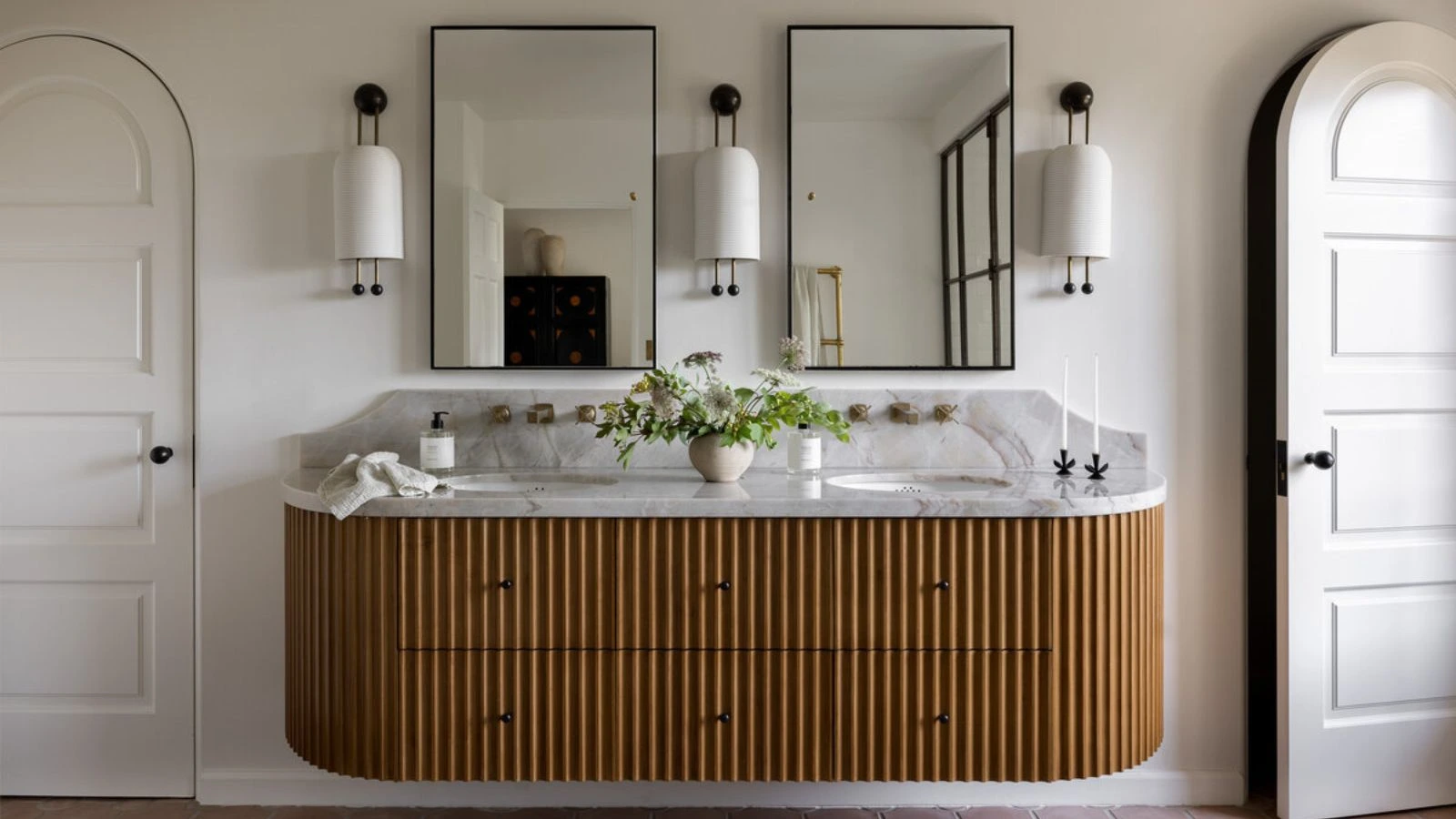
Both work, and the right choice depends on your mirror and wall. A bar above the mirror is the safe choice for small ensuites and wide mirrors, because one fitting lights the whole glass evenly. A light on each side of the mirror at eye level throws the fewest shadows on your face, which is why makeup artists prefer it, but you need roughly 150mm of clear wall on each side.
Position | Best for | Watch out for |
|---|---|---|
Bar above the mirror | Small ensuites, wide mirrors, single basins | Shadows around the eyes if mounted too high |
Sconces either side | Makeup, shaving and detailed grooming | Needs about 150mm of clear wall each side |
Both together | Larger bathrooms and double vanities | Plan the switching and dimming early |
Using both is the most professional result. The overhead fitting supplies general fill light, and the side lights do the flattering face work. It costs more, so it is worth it where the vanity is used for grooming every day.
How High Should Vanity Lights Go?
Use these as starting points. Your electrician sets the final position, so give them the numbers along with the fitting.
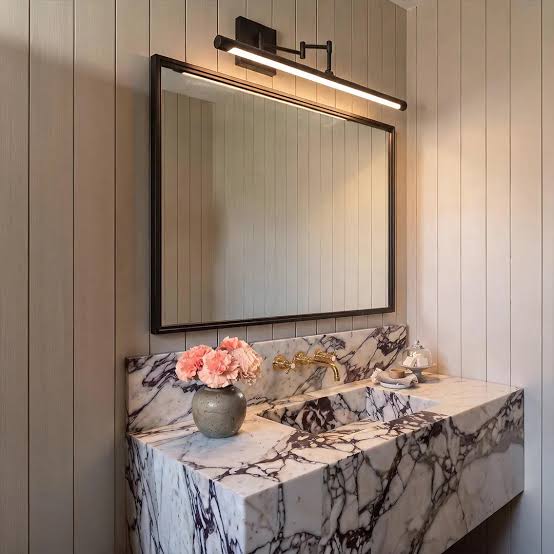
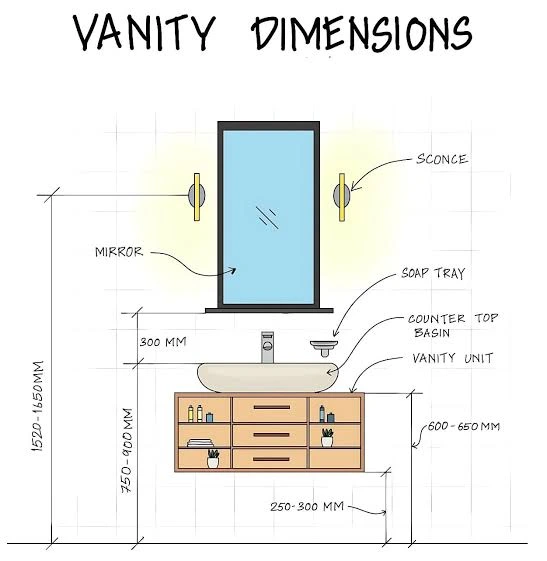
Bar above the mirror: 50 to 100mm above the top edge of the mirror, which on a standard vanity lands around 1,900 to 2,000mm from the floor.
Sconces beside the mirror: centred at eye height, roughly 1,500 to 1,700mm, and a little higher for taller households.
Sconce spacing: about 900 to 1,000mm apart, just outside the edges of the mirror, so light crosses your face from both sides.
Mounting too high is the classic mistake. A fitting up near the ceiling behaves like ambient light rather than task light, and it leaves shadows under the brow, nose and chin.
What Size Vanity Light Do You Need?
As a rule, an above-mirror bar should run roughly 80 to 90 percent of the mirror's width. Much narrower and the light pools in the centre, and much wider than the mirror can look clumsy.
In practice, a 900mm wide mirror suits a bar of roughly 720 to 810mm, and a 600mm mirror suits one of roughly 480 to 540mm. Measure the mirror, not the vanity, because the light is there to serve the mirror.
A lone single-light sconce is rarely enough, so if you choose sconces, use a pair. For a double vanity, treat each mirror as its own zone with its own bar or its own pair of sconces, so both users get an even light.
Vanity Lights by Bathroom Type
Small ensuite: one bar above the mirror lights the whole glass evenly and keeps the wall clear.
Family bathroom: a bar above the mirror gives even light for everyone, and a tri-colour switch suits both quick mornings and relaxed evenings.
Main ensuite with a double vanity: give each mirror its own bar or its own pair of sconces, and aim for 1,600 lumens or more across the vanity.
Powder room: a pair of wall lights beside the mirror in a warm white makes a small space feel calm and flattering.
Choosing Colour Temperature
Colour temperature, measured in kelvin, changes how skin and makeup look. Warm light flatters but can slightly alter colour perception, while cooler light shows colour more honestly.
Kelvin | Look | Best for |
|---|---|---|
2700K to 3000K | Warm, relaxing, flattering | Bathrooms used mostly for relaxing and at night |
3000K to 3500K | Balanced | Most family bathrooms |
3500K to 4000K | Clearer colour, closer to daylight | Makeup and shaving |
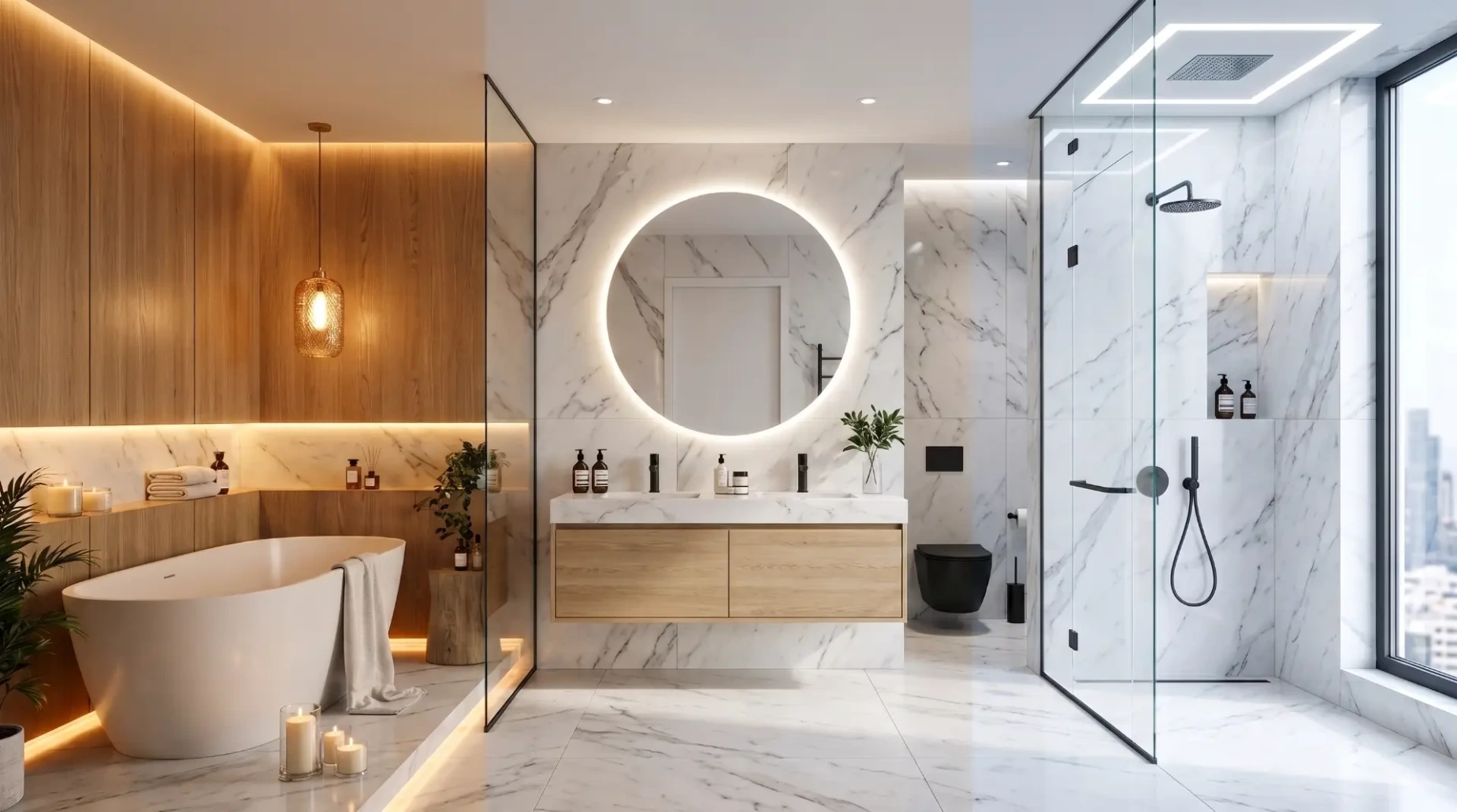
Not sure? Choose a tri-colour fitting with a switch for 3000K, 4000K or 5000K, so you can decide after installation and are not locked in. Keep the general ceiling lights warmer, around 2700K to 3000K, so the room still feels calm at night.
Warm white is also where the industry is heading. Warm 3000K has become a common default for new lighting ranges, which makes it a comfortable, current choice if you would rather not switch between settings.
Pair colour temperature with CRI. A colour rendering index of 90 or higher keeps skin tone and makeup true, and it is a stricter standard than the 80 typically used for general home lighting. CRI scores how accurately a light shows colours on a scale up to 100, so a higher number means truer skin tones.
How Bright Should Vanity Lights Be?
Brightness is measured in lumens, not watts. Compare lumens, because an efficient 12W LED bar can outshine an older 20W one. As a guide, plan for around 700 to 1,200 lumens across a single-basin mirror and 1,600 or more across a double vanity, on top of the room's general lighting.
Dimmable fittings help. You can run them bright and even for the morning routine, then soften them at night. Check that the driver is compatible with your dimmer before you buy, because mismatches cause flicker.
Bathroom Ratings and Safety
Bathrooms are wet, so the fitting must be rated for its location. Check the IP rating on the product page and follow the zone rules that apply to your bathroom. Wiring in wet areas is regulated under AS/NZS 3000 and must be done by a licensed electrician in Victoria.
Near moisture, choose corrosion-resistant finishes such as brushed brass, copper or stainless steel, which cope with steam better than cheaper coatings.
If you are renovating, decide the fitting type before the walls are lined, because a bar above the mirror and a pair of sconces need different wiring positions. It is far easier to plan this at the rough-in stage than to chase cables later.
Match the Finish to Your Tapware
Finish is the last decision. Matching the vanity light to your tapware and hardware makes the room look planned, and chrome is returning in 2026 alongside brushed brass. For more finishes and ideas, see our guide to 2026 lighting trends for Melbourne homes.
Common Vanity Lighting Mistakes
Relying on a downlight above the mirror. It casts shadows under the brow, nose and chin.
Mounting fittings too high or too low, away from face height.
Ignoring CRI, so makeup and skin tones look off under bright light.
Choosing an undersized fitting that leaves the mirror unevenly lit.
Forgetting dimming, so the light feels harsh at night.
Layer Vanity Lights With the Room
Vanity lights handle the face, and the room needs its own layer. Our guide to how many downlights per room covers spacing and colour temperature, and the right LED globes help keep colour temperature consistent across fittings. If you mix downlights and wall lights, keep the kelvin values close so the room does not look patchy.
For efficient high-output options, see our post on COB LEDs. If you are also planning a heat lamp or exhaust fan, our bathroom heating guide helps you plan the ceiling at the same time.
A Quick Planning Checklist
Measure the mirror width and mark the top edge on the wall.
Decide between a bar, a pair of sconces, or both.
Choose 3000K to 4000K, or a tri-colour fitting, with CRI 90 or higher.
Check lumens: 700 to 1,200 for a single basin, 1,600 or more for a double.
Confirm the IP rating and dimmer compatibility on the product page.
Give your electrician the mounting heights and book the installation.
Vanity Lights FAQs
How high should a vanity light be above a mirror?
Mount a bar 50 to 100mm above the top edge of the mirror, about 1,900 to 2,000mm from the floor on a standard vanity. Sconces sit beside the mirror at eye height, roughly 1,500 to 1,700mm.
What colour temperature is best for bathroom vanity lights?
Between 3000K and 4000K works well at the mirror. 3000K feels warm and flattering, while 4000K shows skin tone and makeup more accurately. Look for CRI 90 or higher.
How many lumens do I need for a vanity?
Around 700 to 1,200 lumens for a single basin and 1,600 or more for a double vanity, on top of the general bathroom lighting.
Are vanity lights and mirror lights the same?
In practice, yes. Both are wall lights fitted above or beside a mirror to light your face.
Should vanity lights face up or down?
Choose a fitting that directs or diffuses light downward, rather than bouncing it up off the ceiling. The goal is light landing on your face, not on the ceiling.
Can I put vanity lights on a dimmer?
Yes, if the fitting is dimmable and the driver is compatible with your dimmer. Dimming lets you run bright light in the morning and softer light at night.
Do I need an electrician to fit vanity lights?
Yes, for hard-wired vanity lights in Victoria. A licensed electrician will confirm the position, rating and wiring.
Find Vanity Lighting in Our Showrooms
Bring your mirror width and a photo of the wall to our Truganina or Clyde North showroom, and our team will help you match a fitting, size and colour temperature. You can also browse our indoor wall lights and bathroom collection online, then contact us for advice on bathroom-rated options.